
A.T.A. Personnel Database
All Personnel
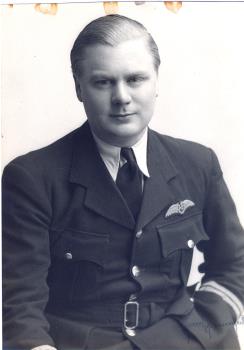
Desmond Roy Huxley
Title:
Other names:
Known as:
ATA Number:
Previous Experience:
Date of birth:
21/10/1911Birth place:
Wandsworth, LondonDate of death:
18/03/1944Place of death:
Oakmere, CheshireNationality:
Great BritainEducation/Employment:
Information
Service and Death
Son of Roy and Olive Huxley, Desmond Roy Huxley was born on 21st October 1911 in Wansworth, London. He learned to fly at Redhill Flying Club where he flew solo for the first time on 9th November 1935. In civilian life he worked as a Wine Merchant and on 16th December 1936 joined the RAF Reserve at Hatfield.
In October 1937 he joined Primeras Lineas Uruguayas de Navegacion Aerea (Pluna) in Montevideo, Uruguay and flew as a pilot for them until March 1938 when he returned to the UK, joining the RAF Reserve Training programme at Hanworth on 17th October 1938 followed by the RAF Volunteer programme at Gatwick in May 1939.
A year later, on 29th May 1939, Desmond joined Air Dispatch Limited at Croydon who flew a daily newspaper flight between London and Paris until the outbreak of World War II. Keen to keep flying, but too old for active service, Desmond joined the Air Transport Auxiliary at White Waltham on 28th June 1940.
Desmond served at many Ferry Pilot Pools during his time with the A.T.A. but one notable incident took place whilst he was serving with 4 Ferry Pool at Prestwick when on 7th August 1942 he was tasked to ferry a Defiant from Lossiemouth to Perth. Whilst flying over inhospitable terrain in the vicinity of Glen Esk, he spotted a pall of smoke rising from a hillside and decided to investigate. On reaching the area he found the smoke to be rising from the burning wreckage of a crashed Wellington bomber, which had struck the side of Muckle Cairn to the south west of Loch Lee. As he circled he spotted a shepherd who, after a quick search of the wreckage, signalled that there were no survivors.
The shepherd set off in the direction of Loch Lee, but Desmond, not entirely satisfied that the search had been thorough enough, continued to circle. His attention was drawn to a person lying on the ground waving a white handkerchief. This person turned out to be the rear gunner from the bomber who had been thrown clear when the aircraft first impacted close to the top of the mountain. Desmond threw the survivor a map, cigarettes, matches and a note telling him that he would report the crash and for him to head in the direction he was flying off in to reach the nearest road. On arriving at Scone Aerodrome near Perth, Flight-Captain Huxley reported his find and a search party was immediately dispatched to the scene.
The aircraft was Wellington L7845 (JT-Z) of 20 Operational Training Unit based at Lossiemouth. It had been on a test flight when it lost part of a cowling, damaging the propellers, causing one of the engines to fail. It crashed as the pilot attempted to carry out a forced landing on the mountain, killing four of the five crew. The rear gunner, Sgt Thomas William Holman, survived when he was thrown clear of his turret breaking his arm and suffering cuts to his face and damaging his back. Following his rescue he stressed the important part Flight-Captain Huxley played in his eventual rescue. For this Desmond Huxley was awarded a Certificate of Commendation on 13th April 1943.
Desmond Huxley left the A.T.A. on 10th January 1944 and joined Fairey Aviation Co. Ltd. as a test pilot at Ringway, Manchester on 1st March 1944. A few days later, on the 18th March, he was killed with his flight engineer, Geoffrey A. Leadbeater, when test flying Halifax LK836, which crashed at Lob Slack Field, off Chester Road, Oakmere, Cheshire, he was 32 years old.
Gallery